I Used Wine as a Sleep Aid for Years — Here’s What Happened to My Sleep When I Finally Quit
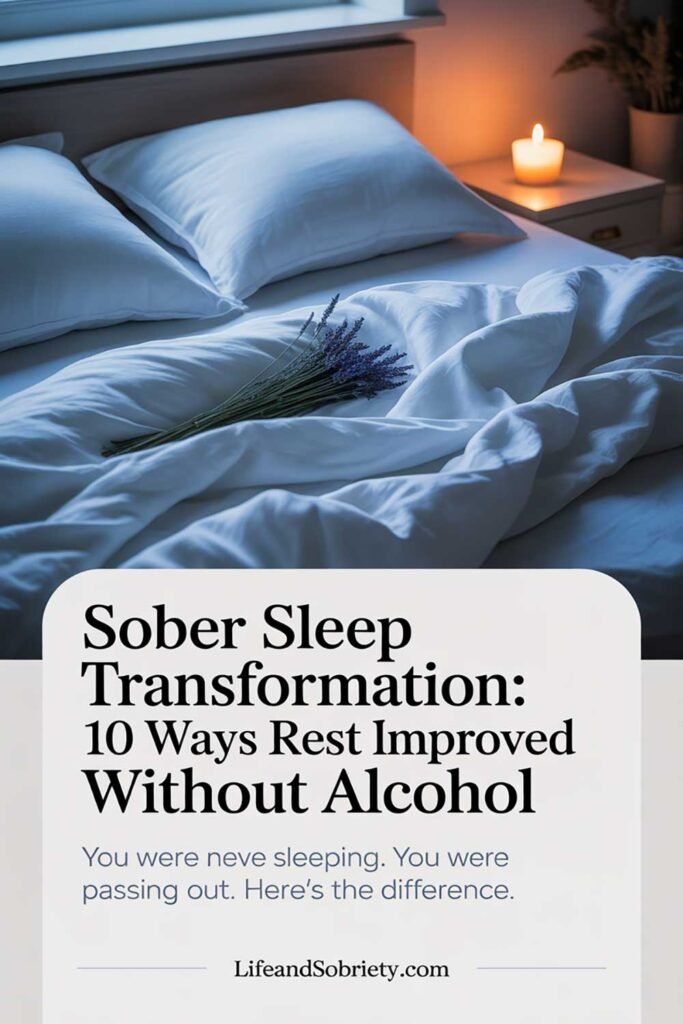
Alcohol helps you fall asleep but destroys sleep quality. It suppresses REM sleep, causes fragmented sleep cycles, and leads to early morning waking. Remove it and your sleep architecture completely transforms — deeper sleep, vivid dreaming, and waking up genuinely rested for the first time in years. This is one of 15 physical transformations that happen after quitting drinking, each documented with real timelines and honest personal experience.
📋 The Science · The Lie · What Actually Happens · The Timeline · Real Stories · FAQ
The Sleep Aid Lie — What Alcohol Actually Does
Wine at night felt like a solution. You were wired from the day. Your mind was still running. The glass of wine switched something off. Your body relaxed. You got drowsy. You fell asleep faster than you would have without it. It worked.
Except it did not work. It just felt like it did.
What actually happened is that alcohol, being a sedative, reduced the time it took to fall asleep. That part is real. But what happens after that is the part nobody talks about when they reach for the glass. While you were sleeping, the alcohol was being metabolized by your liver. And as it metabolized — usually in the second half of the night — the sedation wore off and your nervous system got more active, not less.
The second half of the night was fractured. You may have woken at 2 AM, 3 AM, or 4 AM without knowing why. You may have slept through those wakings but never reached deep, restorative sleep after them. Your body was managing the aftermath of the alcohol, not resting. And the most important part of sleep — REM sleep — was being suppressed through the whole night.
A 2024 systematic review and meta-analysis published in Sleep Medicine Reviews — the largest analysis of its kind, examining 27 studies — confirmed what researchers have suspected for decades: even a low dose of alcohol (around two standard drinks) disrupts REM sleep. Higher doses produce progressively greater REM disruption. And the dose-response relationship is clear: the more you drink, the worse the damage to your sleep quality, even if you feel like you slept longer.
- Fell asleep quickly — that part felt good
- REM sleep suppressed from the start
- First half of night: artificially deep due to sedation
- Second half: nervous system rebounds as alcohol metabolizes
- Fragmented, lighter sleep in the hours before waking
- Early morning waking — usually 3 to 5 AM
- Woke up tired despite “a full night’s sleep”
- Little to no dreaming, or disturbed dreams
- Brain did not process emotions or consolidate memories overnight
- Gradual tolerance — needed more wine to get the same effect
- Takes longer to fall asleep at first — especially in early weeks
- REM sleep gradually returns to healthy levels
- Full natural sleep cycles: light → deep → REM → repeat
- Nervous system stable throughout the whole night
- No alcohol metabolism disrupting the second half
- Sleep through to a natural waking time
- Wake up genuinely rested — sometimes for the first time in years
- Vivid, rich dreaming returns — this is healing
- Brain processes emotions and consolidates memories
- Natural sleep deepens further over weeks and months
What REM Sleep Does and Why Losing It Matters
Most people know that sleep matters. Fewer people know what REM sleep specifically does — and why suppressing it every night for years produces the specific kind of tired and emotionally ragged that heavy drinking creates.
REM stands for rapid eye movement. It is the stage of sleep where dreaming happens. But dreaming is not just entertainment. It is a function. During REM sleep, your brain processes the emotional content of the day — the things that upset you, the things you felt strongly about, the difficult interactions. It consolidates memories. It makes connections between ideas. It restores the emotional centres of the brain for the next day. A night with healthy REM sleep produces a person who is emotionally regulated, mentally clear, and resilient. A night without it produces the opposite.
Research from Elevate Recovery Homes describes it directly: alcohol suppresses REM sleep by up to 50%. This means that a person drinking regularly every night is getting, at best, half the emotional processing and memory consolidation their brain needs. Night after night. Year after year. The emotional fragility, the difficulty handling stress, the feeling of being constantly depleted — these are not character flaws. They are sleep deprivation effects. Specifically, REM deprivation effects.
The 2024 Sleep Medicine Reviews meta-analysis (Gardiner et al.) reviewed 27 controlled studies and found that even a low dose of alcohol — defined as approximately two standard drinks — reduced REM sleep duration by 11.3 minutes compared to nights without alcohol. At higher doses, every additional gram per kilogram of alcohol reduced REM sleep by a further 40 minutes. The researchers concluded that alcohol is not an effective sleep aid and that its use as one represents a public health concern. They noted that alcohol does help people fall asleep faster at high doses — but that this shortening of sleep onset latency is accompanied by increasingly severe REM disruption.
The Honest Sleep Timeline — Week by Week
This is the part most sobriety resources skip over or soften. The sleep timeline after quitting alcohol is not a straight line upward. The first two weeks are often harder than the nights you were drinking. If you are in those first two weeks right now and struggling to sleep, this is why — and it is not a sign that something has gone wrong.
1–7
This is the most difficult sleep period for most people. Your nervous system had been relying on alcohol to slow it down at night. Without it, it does not know how to quiet itself yet. Falling asleep is genuinely hard. You may lie awake for hours. When you do sleep, you may wake frequently. There can be night sweats, restlessness, and anxiety.
This is normal. This is your brain beginning to heal. It is not a sign that you need alcohol to sleep. It is a sign that your brain was dependent on it to sleep and is now learning how to do it without chemical assistance. Push through. This phase passes.
8–21
The insomnia is still present but may be easing slightly. You are getting longer stretches of sleep. And something new is happening: the dreams. They are vivid. Sometimes disturbing. Sometimes you dream about drinking. Sometimes the dreams are so intense they wake you.
This is called REM rebound. Your brain is catching up on all the REM sleep it has been suppressed from having. It overcompensates — flooding you with REM periods that are longer and more intense than normal. The vivid dreams are not a problem. They are proof that your sleep architecture is healing. The emotional processing that was blocked for years is starting to happen. It is intense. It is also necessary.
22–42
Most people notice a real shift here. You are falling asleep more easily — not from sedation, but from natural tiredness. You are staying asleep longer. The early morning waking that was characteristic of alcohol sleep is reducing. The REM rebound dreams are calming down from their initial intensity.
The sleep you are getting in this period is different from the alcohol sleep you had before. It is lighter in the sense of being less sedated — but deeper in the sense of actually being restorative. You may notice you feel different when you wake up. Less groggy. More present. You have not felt this way in a while. Notice it.
43–90
Sleep quality in this period starts to feel genuinely good. Full natural sleep cycles — light sleep, deep sleep, REM, back to light — are completing properly. Sleep onset is now typically within 15 to 20 minutes without any sedative help. You are waking up feeling rested. Sometimes more rested than you can remember.
The emotional regulation that comes with restored REM sleep is becoming noticeable. You may find you handle difficult days differently. That you are less reactive. That stress does not sit as heavily. This is not just sobriety. This is what your brain does when it is properly rested for the first time in years.
Months
Most people in long-term recovery describe the sleep at six months as the best of their adult lives. Not compared to drinking. Compared to everything. Compared to how they slept before drinking became a regular feature of their evenings. The sleep cycles are optimal. The REM periods are healthy. The deep sleep is restorative.
The cascade effects become visible: better immune function, clearer thinking, improved memory, reduced anxiety, more stable moods, better skin, more energy — all connected to the restoration of sleep that alcohol had been systematically destroying.
When you drink regularly, alcohol acts on the GABA neurotransmitter system — the brain’s primary inhibitory system. GABA slows the nervous system down. Alcohol amplifies this effect artificially, which is how it produces sedation. Over time, the brain compensates by downregulating its own GABA activity. When you remove alcohol, the nervous system is temporarily hyperactive — there is not enough inhibitory signal without the alcohol that was providing it. This hyperactivity is what makes falling asleep so hard in the first weeks. The GABA system rebalances over two to four weeks. Natural melatonin production also improves as the circadian rhythm restores. The insomnia is a symptom of the rebalancing. It ends when the rebalancing is complete.
📖 More on Physical Recovery and Sober Life at Life and Sobriety
- →The Energy That Comes Back When You Quit Drinking
- →The Sober Glow Up: What Your Face, Skin and Body Look Like After Quitting
- →Sober Beauty: The Skin and Hair Transformation After Quitting Alcohol
- →19 Recovery Tools That Actually Work
- →100 Days Sober: What Changed and What I Didn’t Expect
- →Sobriety Is Not Willpower — It Is Routine
Real Stories of Sleep Transforming in Recovery
Danielle had been waking up at 3 AM for years. She thought it was anxiety. She thought it was getting older. She thought it was just the way she slept. She would lie there in the dark for an hour, sometimes two, her mind running through every difficult thing she could think of. Then she would fall back asleep and wake up exhausted. She drank every evening to wind down — usually two glasses of wine, sometimes three.
When she got sober, she was prepared for the insomnia she had read about. The first week was exactly as hard as described. She barely slept. The second week was a little better but still difficult. In the third week the vivid dreams started — intense, sometimes disturbing, often involving alcohol. She felt like she was sleeping strangely. But she was sleeping.
At six weeks sober, the 3 AM waking stopped. Not gradually — it just stopped. She slept through. She woke up at her normal time feeling different. Rested in a way she could not quite describe. She had spent years thinking her 3 AM waking was anxiety or aging or just the way she was made. It was the alcohol metabolizing. Every night. Pulling her out of sleep at exactly the window when it had fully left her system.
I did not know that 3 AM was a sign. I thought it was just me — just my brain, just anxiety, just getting older. When it stopped after six weeks of sobriety I understood for the first time that it had always been the wine. My liver was done with it by 3 AM and my nervous system woke up. Every night for years. I was not anxious. I was chemically disrupted. When I stopped giving my body the chemical that was disrupting it, the disruption stopped. That sounds obvious now. At the time it was genuinely a revelation.
Marcus had not dreamed — or not remembered dreaming — in years. He knew this because when other people talked about their dreams, he had nothing to contribute. He assumed he just did not dream much. He drank most evenings. Not dramatically — a couple of beers, sometimes a whiskey. It was part of winding down. He did not think of it as affecting his sleep. He fell asleep easily and woke up mostly functional. He thought his sleep was fine.
At day fourteen of his sobriety, the dreams started. Not gentle or pleasant dreams. The first ones were disturbing — vivid scenes that he woke from disoriented and sweating. He nearly relapsed at day sixteen because of them. He called someone from his support group at 2 AM after one particularly intense dream and was told: this is REM rebound, it is normal, it is temporary, it is your brain healing.
He stayed sober. The dreams changed over the following weeks. They became less disturbing and more rich. He was dreaming about real things from his life. Processing things. At three months, he described his sleep as something he actively looked forward to. He had not had vivid dreams since his early twenties. They came back because he stopped suppressing the stage of sleep that produces them.
I thought I just did not dream. I have dreamed vividly every night for the last eight months. What I actually did not have was REM sleep — the part where dreaming happens. The alcohol was removing it. When I stopped the alcohol, my brain came back for all the REM it had been missing and it came back loudly and intensely and all at once. The week-two dreams were terrifying. But they were also proof that something was working in me that had not worked in years. My brain was doing what brains are supposed to do. I had forgotten what that felt like.
The sleep is coming. It takes longer than you want. It arrives.
If you are in the first two weeks of sobriety and the sleep is worse than it was when you were drinking — you are in the hardest part. The GABA system is recalibrating. The REM is rebounding. The nervous system is learning to quiet itself without the chemical that was doing it artificially. This is not a reason to go back. This is the reason to stay. The sleep on the other side of this phase is not just better than alcohol sleep. It is genuinely, measurably, life-changingly better.
By six months, most people describe the best sleep of their adult lives. Not better than the nights before sobriety when they drank. Better than everything. The full restoration of REM sleep, of healthy sleep cycles, of natural sleep architecture — it produces a person who wakes up genuinely rested, emotionally regulated, and mentally clear in ways that alcohol sleep never produced.
Push through the difficult early weeks. The vivid dreams are healing. The early-morning wakings that replaced the 3 AM alcohol wake-ups will settle. The brain knows how to sleep. It is just relearning how to do it without the sedative it relied on for years. Give it time. The sleep is coming.
Frequently Asked Questions
Why does alcohol make you fall asleep but then wake you up early?
Alcohol is a sedative, which is why it shortens the time it takes to fall asleep. But as your body metabolizes the alcohol — usually in the second half of the night — it produces a rebound effect. The sedation wears off and the nervous system becomes more active. This causes lighter, more fragmented sleep and often pulls you out of sleep entirely in the early morning hours — usually between 3 and 5 AM. The earlier you wake, the more completely the alcohol has metabolized. This is one of the most consistent signs that alcohol is disrupting your sleep rather than helping it.
Why can’t I sleep when I first quit drinking?
When you quit drinking, your nervous system has to recalibrate without the sedative effect it had come to rely on. In the first one to two weeks, many people experience difficulty falling asleep, frequent waking, restlessness, and night sweats. This is normal and temporary. It happens because alcohol artificially suppressed the nervous system and the brain has to relearn how to produce its own sleep signals. The insomnia of early sobriety is a sign of healing, not a sign that something is wrong. Most people begin to see real improvement between weeks two and six.
What are the vivid dreams in early sobriety?
Vivid, intense, and sometimes disturbing dreams are very common in the first weeks and months of sobriety. This is called REM rebound. Alcohol suppresses REM sleep — sometimes by up to 50% — and when alcohol is removed, the brain tries to catch up on all the REM it has been missing. REM periods become longer and more intense than usual. The dreams can be vivid, emotional, or involve drinking. All of this is normal and is actually a sign that your sleep architecture is healing. REM rebound typically calms down within a few weeks to a couple of months.
How long does it take for sleep to improve after quitting alcohol?
The timeline varies between people, but research and lived experience point to a consistent pattern. The first one to two weeks are often the hardest — insomnia, frequent waking, vivid dreams. Weeks two to four usually bring gradual improvement in sleep duration. Days 30 to 90 is when most people notice real, meaningful change — falling asleep more easily, staying asleep, waking up feeling rested. By six months, most people in recovery describe the best sleep of their adult lives. The full restoration of healthy sleep architecture takes time, but it does happen.
🛍️ Visit Our Shop
A Daily Reminder That Rest Is Your Birthright
Hand-picked mugs and recovery-minded products — small daily reminders that you are building something real, one sober night at a time.
Browse the Shop →Important Disclaimer & Affiliate Notice
Educational Content Only: The information in this article is for general educational and informational purposes only. It is not intended as a substitute for professional medical, clinical, or therapeutic advice.
Not Professional Medical Advice: Life and Sobriety, its founder Don, and its contributors are not licensed physicians, addiction specialists, or medical professionals. Nothing in this article should be interpreted as personalized medical advice. If you are experiencing alcohol dependence or planning to stop drinking after a period of heavy or long-term use, please consult a qualified healthcare professional before doing so.
Medical Safety Notice — Alcohol Withdrawal: For people with significant alcohol dependence, stopping alcohol abruptly can cause serious and potentially life-threatening withdrawal symptoms including seizures and delirium tremens. The insomnia and sleep disruption described in this article are normal aspects of recovery — but they are distinct from clinical withdrawal symptoms that require medical supervision. If you have been drinking heavily for a long time, please seek medical supervision when stopping. In the US, SAMHSA’s National Helpline is available 24/7 at 1-800-662-4357. If you are in a medical emergency, call 911 or your local emergency number.
Mental Health Resources: If sleep difficulties, anxiety, or other challenges associated with early sobriety are significantly affecting your well-being, please consult a qualified mental health professional. Call or text 988 for the Suicide and Crisis Lifeline.
Research References: The primary research source for the sleep science in this article is a systematic review and meta-analysis by Gardiner et al. published in Sleep Medicine Reviews in November 2024 (Vol. 80, Article 102030), examining 27 studies on the effect of alcohol on sleep architecture. The finding that REM sleep was reduced by 11.3 minutes at low alcohol doses, and by 40.4 additional minutes per gram per kilogram of additional alcohol, is from this review. The description of REM rebound is drawn from clinical literature including Palmer Lake Recovery, Elevate Recovery Homes, and the National Addiction Specialists. The GABA neurotransmitter explanation is based on established neuroscience of alcohol sedation. All research is described in accessible terms for a general audience.
Real Stories Notice: The stories in this article are composite illustrations representing common experiences. They do not depict specific real individuals.
External Links & Resources: This article may contain links to external websites. Life and Sobriety does not control and is not responsible for the content, accuracy, or practices of any third-party site.
Affiliate Disclosure: Life and Sobriety may contain affiliate links. If you make a purchase through one of our links, we may earn a small commission at no additional cost to you. We only recommend products and services we genuinely believe in.
Copyright Notice: All original content on this website is the copyrighted property of Life and Sobriety unless otherwise noted. Reproduction without written permission is strictly prohibited. Please check our full disclaimer page, privacy policy, and terms of service for the most current information.
Copyright © Life and Sobriety · All Rights Reserved · Building a Life Worth Living, One Sober Day at a Time